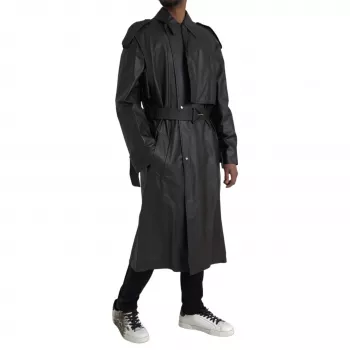
A leather trench coat brings structure, sheen, and weight in a way fabric outerwear can’t. The Bottega Veneta Black Leather Trench Coat Jacket pairs a classic trench silhouette with a modern, minimal finish, making it a statement layer that can still function as a daily uniform piece when styled with intention. The result is polished without feeling overly “done”—especially in black, where leather’s natural depth reads rich and dimensional rather than flat.
Even when the cut is traditional, leather changes how a trench behaves on the body and in motion. It tends to look sharper from a distance, holds its line longer throughout the day, and adds warmth without relying on bulk.
Black leather is a shortcut to a streamlined wardrobe because it pairs easily with denim, tailoring, and knitwear while keeping the overall look cohesive. With a longer trench line, the eye moves vertically, which can make outfits look longer and more “finished” without extra styling.
If the rest of the outfit feels too “busy,” edit down accessories. A single strong element—like a structured bag or a minimal watch—often looks more intentional than stacking multiple statement pieces.
For shoppers building a small, high-impact outerwear rotation, this piece functions as both a signature layer and a versatile topcoat for evenings, commutes, and travel days.
| Detail | Value |
|---|---|
| Product | Bottega Veneta Black Leather Trench Coat Jacket |
| Price | 10415.71 USD |
| Availability | In stock |
| Primary material | Leather (as listed) |
| Color | Black |
| Product page | View product |
Leather coats typically feel more substantial than fabric trenches, even when the measurements look similar. Prioritize how the coat fits across the shoulders and upper back; the waist and sweep can be adjusted with the belt.
If you’re between sizes, choose based on your real-life use: a thin tee and sleek tailoring favors a closer fit, while frequent cold-weather layering benefits from a touch more room.
A black leather trench earns its place when it can move from weekday uniform to dinner plans with minimal changes. The goal is contrast through texture—denim, knits, and polished leather—rather than loud prints.
For travel, a leather trench is especially useful: it reads polished upon arrival and can be worn open indoors without looking bulky or overly casual.
Leather rewards consistent, low-effort care. The biggest enemies are prolonged saturation, heat-drying, and tight storage that encourages creases and surface scuffs.
For practical, step-by-step guidance on cleaning and conditioning, see Wirecutter’s overview of leather care basics. For general guidance around accurate material marketing and disclosures in fashion categories, the FTC’s industry guides are a helpful reference point.
Focus on shoulder fit first, since leather is harder to alter there; the waist and shape can be adjusted with the belt. Leave enough room for layering if you’ll wear it in cooler weather, and make sure the sleeves don’t feel restrictive when you move your arms.
Occasional light rain is usually fine, but avoid letting the coat get soaked. If it gets wet, blot gently with a clean cloth and let it air-dry away from direct heat sources.
Use a wide, supportive hanger and give the coat space so it doesn’t rub against other items. If you need a cover, choose something breathable and avoid sealing it in plastic for long-term storage.









Leave a comment