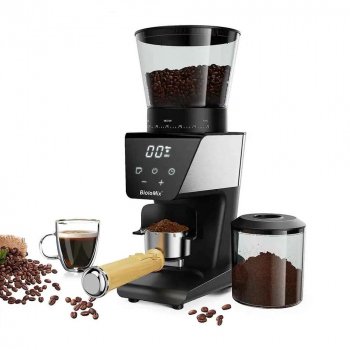
Consistent grind size is the foundation of great coffee. An automatic conical burr grinder with a wide range of settings and an LCD timer makes it easier to repeat the cup you loved yesterday—whether you’re dialing in espresso, refining a pour-over, or keeping a dependable drip routine on busy mornings. If you’re upgrading from pre-ground coffee or a blade grinder, the jump in clarity, balance, and control is usually immediate.
If you’re shopping for a grinder that’s built around repeatability, the Automatic Conical Burr Coffee Grinder with 30 Settings and LCD Timer is designed to help lock in the variables that matter most: grind size and dose timing.
| Feature | What it means for brewing | How to use it well |
|---|---|---|
| 30 grind settings | Lets the same grinder adapt to different brew methods | Start mid-range for drip, finer for espresso, coarser for French press; adjust one step at a time |
| LCD timer | Repeatable grind time for similar dose output day to day | Lock in a time that matches the basket/filter size, then tweak based on taste |
| Conical burrs | More consistent grind than blade grinders, improving extraction balance | Avoid rushing adjustments; give the grinder a moment to clear between changes |
| Automatic workflow | Less manual effort and fewer variables during morning prep | Keep a consistent routine: same beans, same setting, same timer, then calibrate when beans change |
The main reason burr grinders are so widely recommended is simple: they aim to produce a tighter spread of particle sizes. When grounds skew too fine, water extracts too much too quickly and bitterness can dominate. When grounds skew too coarse, water under-extracts and the cup can taste sour, thin, or hollow.
For additional brewing guidance and method-specific best practices, the Specialty Coffee Association and the National Coffee Association offer helpful foundational resources.
Think of the 30 settings as a map: you’re choosing how fast water should move through the coffee and how much surface area is exposed. Use these as starting points, then let taste (and brew time) steer small adjustments.
A practical routine is to change only one step at a time. That keeps your feedback clean: if the cup improves, you’ll know why. If it gets worse, it’s easy to reverse.
Weighing is the most precise way to dose coffee, but time-based grinding is a fast, repeatable shortcut once it’s set. The LCD timer makes it easy to return to the same grind duration for the same bean and setting—ideal for weekday mornings or households where multiple people make coffee.
Yes for most coffee brewing, because burrs produce more consistent particle sizes, which helps extraction stay balanced. Blade grinders tend to create a mix of powdery fines and larger “boulders,” which can make the same cup taste both sour (under-extracted pieces) and bitter (over-extracted fines).
Move from fine for espresso to medium for drip and coarse for French press. Adjust one step at a time based on flow time and taste: faster and sour usually needs a bit finer, while slow and bitter usually needs a bit coarser.
The timer is convenient for repeatability once dialed in, but weighing is still more precise for controlling dose. A good approach is to calibrate the timer occasionally with a scale so the timed dose stays close to your target.









Leave a comment