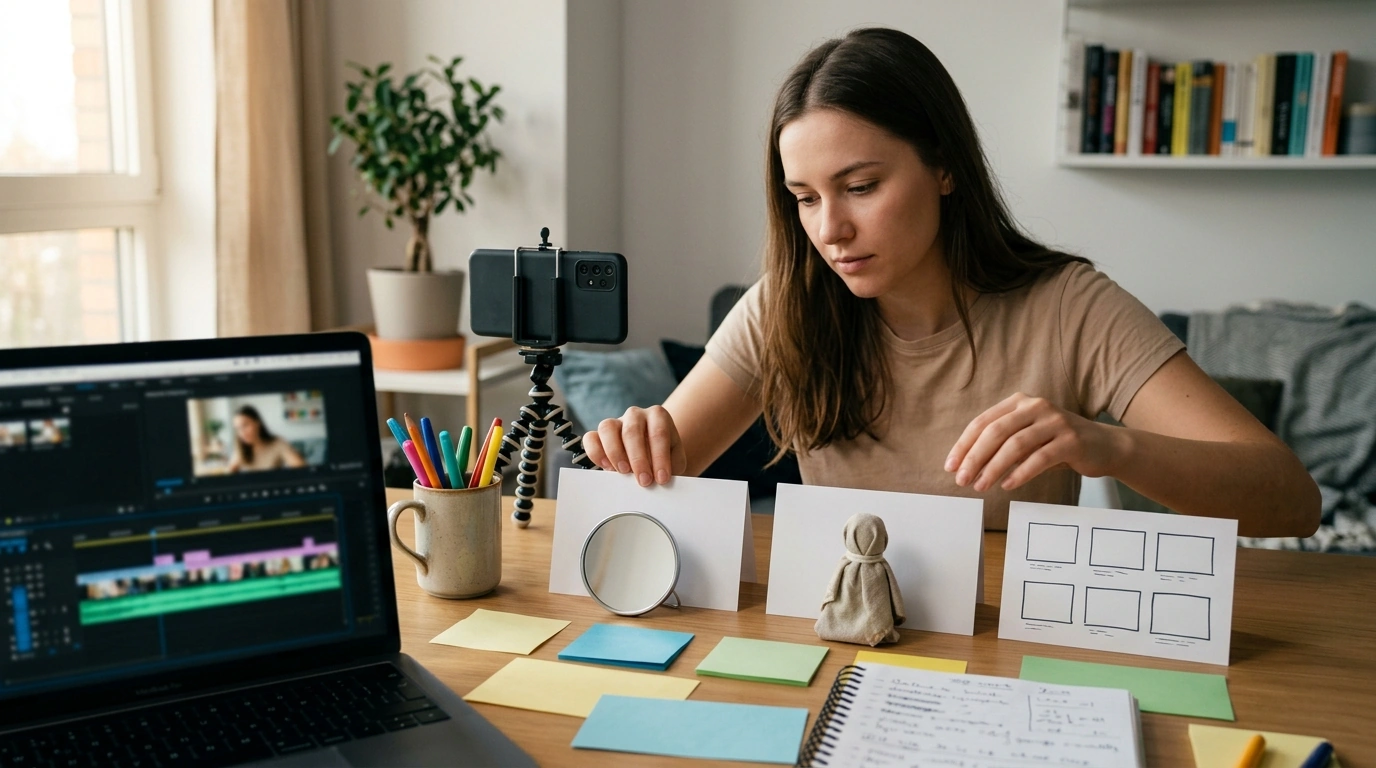
The first second decides whether a viewer stays or swipes. The most reliable way to earn that second (and the next ten) is to choose an opener style that matches the payoff you can deliver: emotion, curiosity, or story. Below is a practical breakdown of when each hook wins, how to write it without sounding rehearsed, and how to test variations so watch time climbs without changing your whole content plan.
Retention is built (or lost) before the topic is fully revealed. Your opener sets expectations for the pace and the payoff, which is why “getting to the point” is less about speed and more about clarity. A strong hook makes a clear promise—an emotion the viewer recognizes, a surprise they want explained, or a narrative outcome they need to see resolved.
Good openers also reduce confusion. The viewer should immediately understand what to watch for (a result, a mistake, a comparison, a transformation). When that “gap” is obvious—something unresolved that feels close to being solved—watch time and rewatches tend to rise because the brain wants closure. For platform-level guidance and trend examples, TikTok’s Creative Center is a useful reference point.
All three hook styles work; the best one depends on what you can show early and what your audience is already primed to care about. Education often favors curiosity, lifestyle often favors emotion, and transformation arcs often favor story. Use the table below as a fast chooser, then tailor the wording to your voice.
| Opener type | Best for | Fast template | Common mistake | Quick fix |
|---|---|---|---|---|
| Emotion | Relatable struggles, wins, before/after, reviews | “If you’ve ever felt ___, do this…” | Being vague (“This is crazy!”) with no context | Name the feeling + the situation in 7–10 words |
| Curiosity | Tips, hacks, myth-busting, product demos, tutorials | “Stop doing ___. Do this instead.” | Over-teasing without payoff | Promise a specific reveal and deliver it within 3–5 seconds |
| Story | Personal journeys, case studies, behind-the-scenes, challenges | “I had 24 hours to ___…” | Too much setup before the conflict | Start at the turning point, then backfill in one line |
Emotion hooks work when they feel like a real human reaction, not a staged headline. The simplest method is the “micro-confession”: one sentence that’s specific enough to be believable, short enough to be punchy, and honest enough to lower skepticism.
Examples to adapt: “This fixed my anxiety about ___.” “I was embarrassed by ___ until I tried this.” “This made me oddly proud…” If you want a ready-to-use set of frameworks and fill-in templates, Mastering TikTok Openers: Emotion vs Curiosity vs Story Openers – The Ultimate Guide for Captivating Content is built specifically for fast scripting and iteration.
Avoid empty suspense. The first 2–3 cuts should show progress: the setting being changed, the tool being used, the test running, or the “wrong vs right” comparison starting. If you reference trends or best practices, keep it tethered to proof—HubSpot’s video marketing resources are a solid overview of what tends to improve engagement across formats.
Examples to adapt: “I almost ruined ___, then this happened.” “Day 1 vs Day 7 of ___.” “I said yes to ___ and regretted it—until…” For creators who film at night or need a dramatic “lights on” reveal as a first-frame pattern interrupt, a prop like the Solar-Powered Motion Sensor Alarm Light can create an instant visual shift without complicating the script.
Captions should spotlight the promise word (the feeling, the reveal, or the outcome), not summarize the whole video. Add a pattern interrupt within 1–2 seconds: a cut, zoom, prop change, or an on-screen result. Then practice payoff discipline—deliver the core reveal early, then expand with proof, steps, and examples. For behind-the-scenes builds or “fix it fast” content where you need a crisp visual action right away, the Electric Precision Screwdriver Set for Small Electronics can help you capture satisfying, step-based footage that supports curiosity hooks.
Slow visuals: Show the end result first (screenshot, finished look, metric, reaction), then rewind. No next step: End the opener with a directional phrase like “watch what happens when…,” “here’s the exact setting…,” or “the mistake is…” For platform updates and official feature notes that can inspire timely curiosity hooks, TikTok’s Newsroom is a reliable source.
Curiosity hooks often win for tips and tutorials because they create an immediate “information gap” and let you show the fix fast. Emotion hooks work well when the lesson is tied to a relatable pain point, and a mini story can frame the lesson when you can open on a mistake or a surprising result. Choose based on your first visual: if you can show the solution instantly, go curiosity; if you can show a reaction instantly, go emotion; if you can show tension instantly, go story.
Aim to deliver the core promise in about 1–3 seconds, then show proof as quickly as possible. The “reveal” can happen early while the explanation continues, as long as the viewer feels forward progress immediately.
Film multiple hook intros and swap them into the same video body so only the opener changes. Use drafts or spaced-out iterations and compare retention signals like 2-second hold, average watch time, rewatches, and the quality of comments. Keep variables controlled (length, captions, first frame, pacing) to make the results meaningful.










Leave a comment